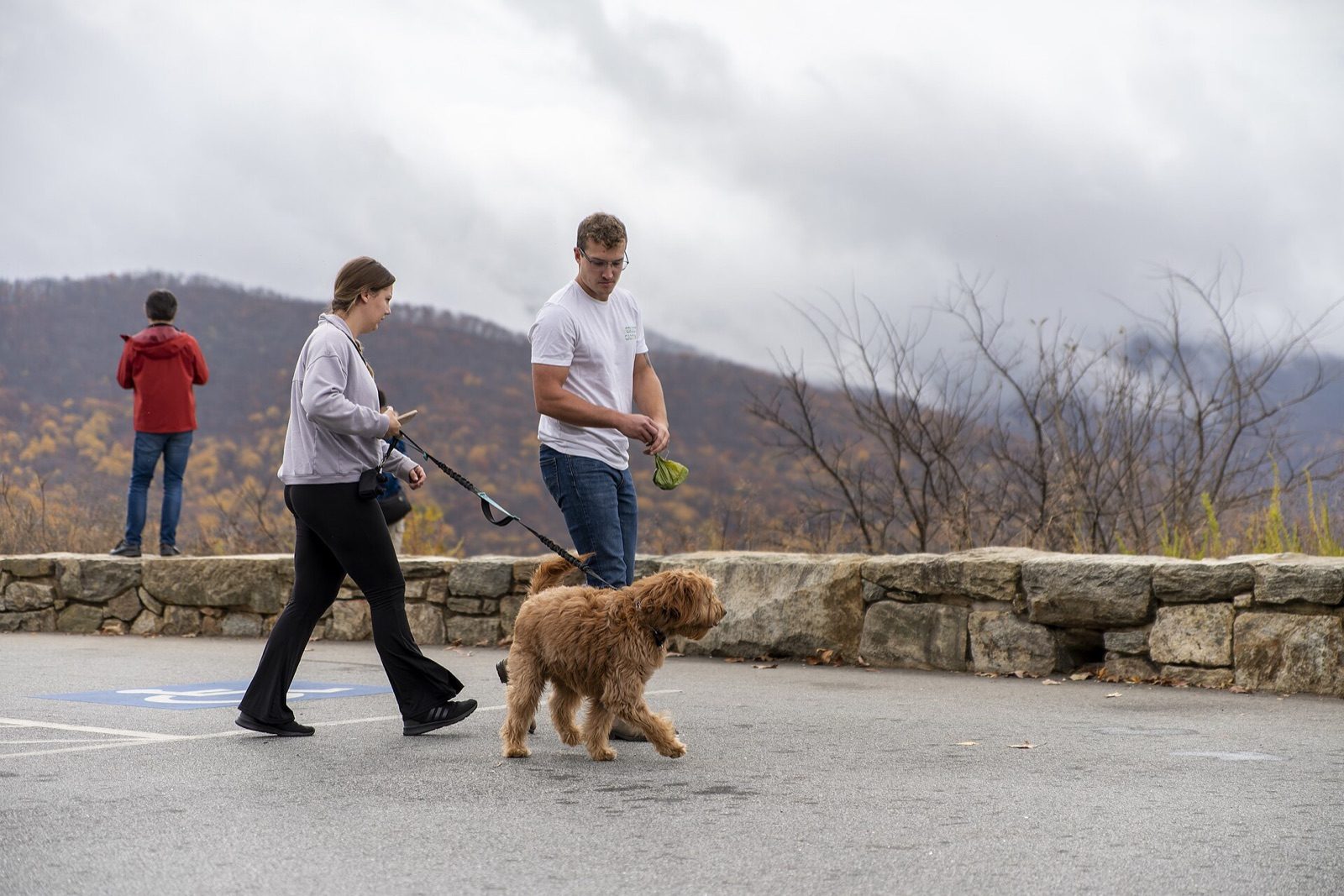
Dog-friendly national parks for fall and winter
Plenty of national parks keep dogs to roads, parking lots and campgrounds. Arches, for one, bans pets from every trail and overlook, even in a carrier. The six parks below are different. Your dog can put in real miles with you, on trails, carriage roads, rim paths or open sand.
Start with parks that actually let dogs on the trails. Acadia, Shenandoah, Cuyahoga Valley, Petrified Forest and White Sands all let leashed dogs onto real trails, and Grand Canyon's South Rim allows them above the rim. Do the leafy eastern parks in October. Save the desert parks for after the summer heat is gone. Wherever you go, the leash can't be longer than 6 feet. All six parks here use that rule, and each has a few spots where dogs can't go.
Jump to:
- Why these parks, and why now
- The rules every park shares
- Best time to go, park by park
- Two road trips that link the parks
- Winter driving and closures
- When your dog can't come along
- A note on the Smokies
- Mistakes to avoid
Updated Oct 1, 2026
Why these parks, and why now
The cooler months help too. The eastern parks peak with fall color, and once summer's over the desert parks are far easier on paws, and on a dog waiting in the car. Match the region to the season, and book a night at a pet-friendly motel near the gate so you can get an early start.
For each park below you'll find what's open, what's off-limits and a few tips. Read the park's own pet page before you go as well, because rules change and the closed-trail lists are specific.
The rules every park shares
The NPS boils it down to B.A.R.K.: Bag your pet's waste, Always leash your pet, Respect wildlife, and Know where you can go. In practice, that's a leash no longer than 6 feet, waste bags in every pocket, and a quick look at the park's pet page before you go.
Buildings are the other usual limit. Visitor centers and other park buildings generally admit only service animals, so bring a second person or plan to take turns. Ranger programs are often off-limits to pets too; Shenandoah and Acadia both say so.
And don't leave your dog alone. White Sands is explicit about it: pets can't be left unattended or tied to objects anywhere in the park. The same common sense applies at every stop on this list.
Best time to go, park by park
Shenandoah: October is the classic month for color on Skyline Drive. The park's winter season usually runs November through February, with average daytime temperatures of 29 to 39°F, and winter weather can turn up any time from October to March.
Acadia: go in fall, before December 1. From then until April 14, the Park Loop Road is closed to cars except for two short sections, though the carriage roads stay open year-round, with seasonal closures.
Cuyahoga Valley: fall is the easy call, and the trails stay open in winter. The park asks for extra caution on icy, snowy or muddy trails, and dogs are kept off Virginia Kendall Hills on sledding days.
The Southwest parks: winter is the whole point. The Grand Canyon's South Rim is open year-round and quieter in January and February. Petrified Forest swings from above 100°F in summer to well below freezing in winter, so a cool, sunny winter day is ideal for a dog.
Two road trips that link the parks
In the East, start in Front Royal at milepost 0 of Skyline Drive. The drive runs 105 miles along the Blue Ridge and takes about three hours end to end, with a 35 mph limit in most places, so there's plenty of time for leashed walks at overlooks and trailheads. Cuyahoga Valley in northeast Ohio is a natural second stop after that, and Acadia is a separate trip up the Maine coast.
In the Southwest, follow I-40 in winter. Spend a night in Williams for the Grand Canyon's South Rim, then keep heading east to Holbrook for Petrified Forest. From there, drop south into New Mexico for White Sands and base yourself in Alamogordo.
Plan the days around your dog, not the map. Shorter driving days with a long walk in the middle beat one long push, and every park on this list has enough leashed walking to fill a morning.
Winter driving and closures
Fill the tank before Skyline Drive. Shenandoah has one gas station, at Big Meadows Wayside, and its pumps can be unreliable. In winter the drive can close for snow or ice, and crews can take several days to reopen it, though the park stays open to hikers on foot.
At the Grand Canyon, the park spreads rock cinders rather than salt, so take it slow on cold mornings. Chains generally aren't required. Check AZ 511 before you go.
At White Sands, the road into the park can close for up to three hours during missile tests, and US 70 between Alamogordo and Las Cruces closes at the same times. In winter the park can also close without notice for unsafe roads or extreme weather. Gates open at 7 a.m., and outside the summer season the park closes 30 minutes after sunset.
When your dog can't come along
Every park here has places a dog can't go, so plan around them. At the Grand Canyon, the South Rim kennel near Maswik Lodge takes dogs and cats with proof of current vaccinations. That's your answer if you want to hike below the rim, which pets can't do.
For visitor centers and other buildings, take turns: one of you goes in while the other walks the dog around the parking area. At Petrified Forest you can do better than the parking lot. The fenced Bark Park next to the Painted Desert Visitor Center lets your dog stretch out while you wait.
Some of the best-known park experiences are people-only. At Cuyahoga Valley, only service animals can ride the scenic railroad, and at the Grand Canyon pets can't board the shuttle buses. On those days, split it up: a long leashed walk on the Towpath or the rim trail first, then a rest for your dog while you take the train or shuttle, with someone staying behind or a kennel booked.
Whatever you do, keep your dog's routine close to what it is at home. Feed at the usual times, keep walks predictable, and bring a familiar bed or blanket for the motel room at night.
A note on the Smokies
Great Smoky Mountains is a hard park to do with a dog. Only two trails allow pets: the Gatlinburg Trail and the Oconaluftee River Trail. Dogs can still ride along on the park roads and stop with you at picnic areas and front-country campgrounds.
If you want miles of trail with your dog, Shenandoah is the better choice. If you do go to the Smokies, plan your walks around those two trails and keep the leash at 6 feet or shorter.
Mistakes to avoid
Don't assume a carrier gets your dog onto a closed trail. At parks like Arches, it won't. And don't count on the shuttle at the Grand Canyon: pets can't ride the buses, so you'll be driving between viewpoints.
Read the closed-trail lists. Acadia closes its ladder and cliff trails to pets, and Shenandoah closes favorites like Dark Hollow Falls, Stony Man and Old Rag. Finding out at the trailhead means a wasted drive.
And never leave your dog in the car, winter included. Desert sun heats a parked car fast, and cold cars are risky for young, old and thin dogs.